Seattle Houseboats: The Floating Homes of Eastlake and Lake Union
Seattle has 507 floating homes on 70 docks, according to the Floating Homes Association, almost all on Lake Union and Portage Bay, and Eastlake's shore along Fairview Avenue East is one of the places they cluster. The docks are private, so the public views are from Eastlake's street-end parks, from a kayak, or on the association's home tour, next planned for summer 2027.
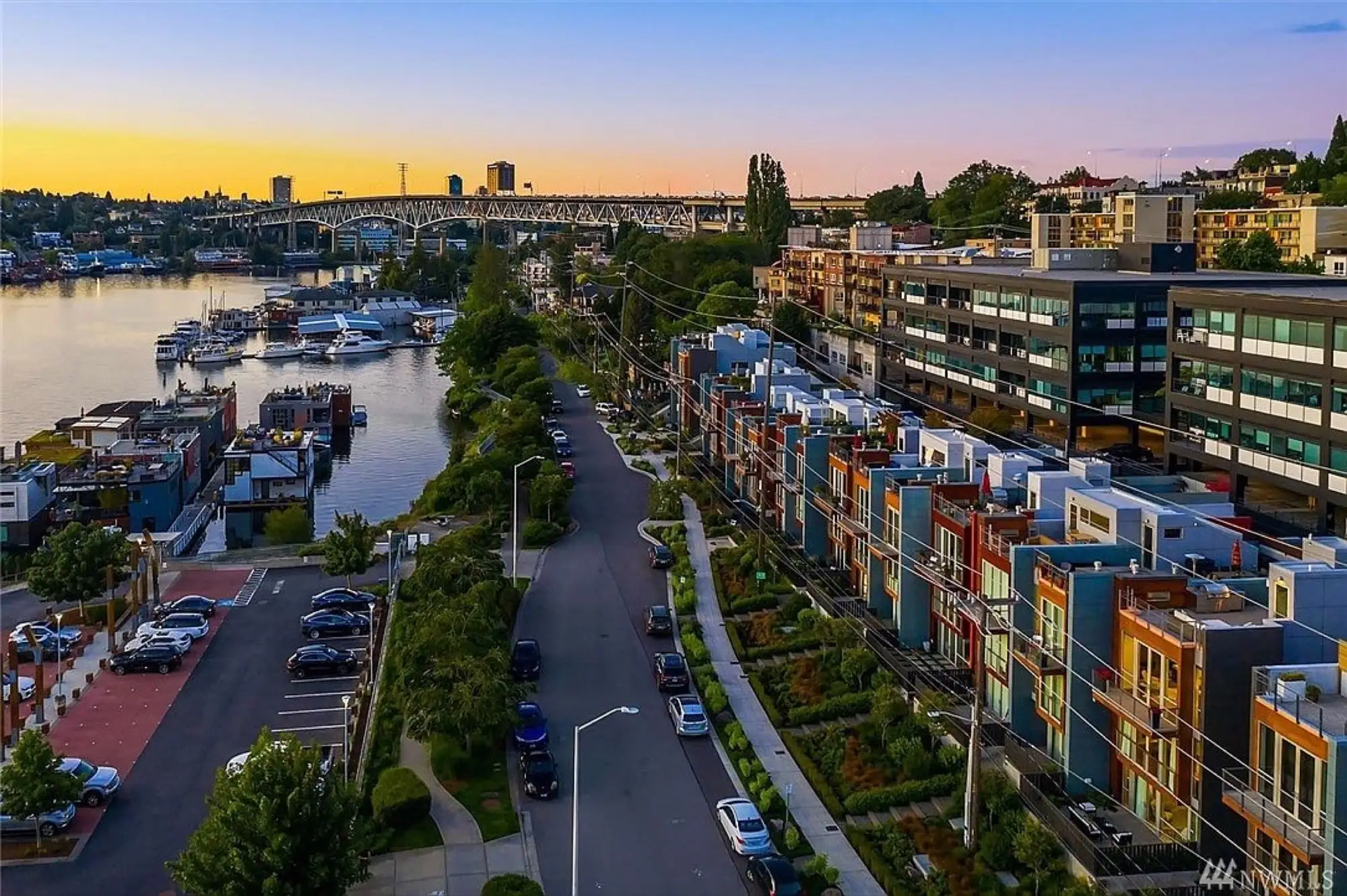
Most of what Seattle calls houseboats are floating homes: houses built on floats, moored in a fixed slip and connected to City sewer, water and power. Eastlake has had them since before the Ship Canal opened. In 2001, HistoryLink described the neighborhood’s houseboats in rows nine and ten deep, reaching out into the lake.
Where are the houseboats in Seattle?
Almost all of them are on Lake Union and Portage Bay. The Floating Homes Association (FHA) counts 70 docks around Lake Union, in Eastlake, Westlake, Northlake, Portage Bay and the University District. Most homes sit on docks their owners control, often as cooperatives, and some rent slips from marina operators.
A century ago, colonies also floated off Madison Park and Leschi on Lake Washington, on Elliott Bay, on the Duwamish River and in Salmon Bay. The City condemned most of the Lake Washington moorages in 1927, and further action in 1938 cleared the homes left between Rainier Beach and Madison Park, according to HistoryLink. The same essay notes that a Lake Union houseboat was a setting for the 1993 film Sleepless in Seattle.
In Eastlake, the docks run off Fairview Avenue East, a street that in places continues underwater. The Eastlake Community Council points out a submerged stretch of Fairview from E Roanoke St to just past E Edgar St.
How many houseboats are in Seattle?
About 500 floating homes, plus a smaller number of other houseboats. The FHA’s maps page counts 507 floating homes on 70 docks, and its history page puts the total at roughly 500 floating homes and 250 residential houseboats. There used to be far more:
| When | Count | Source |
|---|---|---|
| 1922 | 1,100 houseboats on Lake Union, per the City health commissioner | HistoryLink |
| Late 1930s | More than 2,000 in Seattle, with some estimates near 3,000 | FHA |
| Just after World War II | About 2,500 in and around Seattle (an estimate) | HistoryLink |
| Early 1960s | Fewer than 1,000 | FHA |
| 1970 | About 450 | HistoryLink |
| Today | 507 floating homes on 70 docks | FHA |
The number of floating homes is effectively capped. Under Seattle’s shoreline code, a floating home is allowed only if it was legally established, or had a building permit, by June 15, 2015, or if it replaces one that was (SDCI Tip 229).
What is the difference between a houseboat and a floating home?
“Houseboat” is the everyday word for any floating residence. The FHA defines a floating home as one kind of houseboat, with permanent connections to sewer, water and electricity (sometimes gas), a fixed location, and its own tax parcel or personal property tax designation. It cannot legally move from marina to marina.
The City sorts floating residences into four types, plus liveaboards, according to the Seattle Department of Construction and Inspections (SDCI):
- Floating homes, which must be connected to the sewer for all wastewater.
- Floating on-water residences (FOWRs), floating structures used as homes and moored at a Seattle marina before July 1, 2014. The FHA describes them as able to move between marinas, typically with holding tanks that are pumped out.
- House barges, unpowered vessels that have been moored and lived on at a recreational marina since July 1, 1990 or earlier.
- Vessels with dwelling units, which must be able to reach open water under their own power.
Liveaboards are people who live on ordinary recreational boats in marina slips. They do not need the City verification that the four floating residence types do.
Why does Eastlake have so many houseboats?
Because the moorages started there early, and later rules kept floating homes at the moorages that already existed. HistoryLink traces Eastlake’s colony to 1911, when work on the Ship Canal began in earnest and migrant workers built floating shacks tied to existing pilings. After the state’s Shore Lands Sale of 1907, upland owners had been made to buy the underwater lots in front of their land, and they charged rent while they waited for the canal to raise property values. When the economy stalled after World War I, the lots stayed undeveloped and the houseboats stayed too. HistoryLink says more houseboats floated on Lake Union and Portage Bay in 1920 than when it wrote its Eastlake history in 2001.
Eastlake also took in homes pushed off other shores. When freeway construction forced houseboats off Portage Bay in the early 1960s, marine supply owner O. H. “Doc” Freeman extended his three docks in the 2000 block of Fairview Avenue East to make room for 15 newcomers (HistoryLink).
Eastlake lost moorages, too. In 1962 a federal Coast and Geodetic Survey base was built on fill off Fairview Avenue East, and 73 moorages disappeared. That fight led houseboaters to formalize the Floating Homes Association in November 1962. A sewer system around the lake was completed in 1965, and King County dates the houseboat hookups to 1967.
Building over the water was the next fight. In 1969 a developer won a permit for a five-story apartment complex over the lake on Fairview Avenue East, and it was built despite FHA protests. The state’s Shoreline Management Act of 1972 later prohibited projects like it (HistoryLink). In 1971 developers started a 112-unit condominium over the water at the foot of E Roanoke St, known as Roanoke Reef. The FHA and the Eastlake Community Council sued, and it was never finished (HistoryLink). Houseboat docks now use its pilings, according to the Eastlake Community Council.
Under its shoreline rules, the City then allowed floating homes only at existing moorages (FHA). In 1977 Mayor Wes Uhlman signed a revised Equity Ordinance that protected floating home owners who did not own their moorage from unreasonable rent increases and sudden eviction. Seattle Parks credits Terry Pettus, a journalist who moved onto a houseboat in 1958, as a leading voice in that fight; Eastlake’s Terry Pettus Park is named for him.
What rules apply to Seattle floating homes?
Floating homes fall under Seattle’s Shoreline Master Program, in SMC 23.60A.202. Among its standards:
- Every floating home moorage must be on privately owned or privately controlled property.
- Each home must be connected to the sewer for all black and gray water.
- Floats are limited to 1,200 square feet or their existing size, and additions are generally limited to 18 feet high, measured from the main deck or 3 feet above the water, whichever is lower.
- No new living or storage space can be built below the water.
- Each home displays a City registration number on its landward side.
Owners also need City approval before exterior repairs or remodels. Where the lake bottom is state-owned, docks and homes lease it from the Washington Department of Natural Resources, and the FHA notes that floating homes are legally personal property, so they change hands differently from houses on land.
Can you visit the houseboat docks?
The docks are private. The shoreline code requires floating home moorages to be on privately owned or controlled premises, and the homes are people’s homes. The easiest way in is the FHA’s Floating Homes Tour, a self-guided tour of homes not usually open to the public. The 2025 tour, the first in seven years, drew more than 600 visitors to ten homes, and the next is planned for summer 2027.
For a smaller look, the FHA runs what it calls the World’s Smallest Floating Homes Museum at the Keasler Cottage, 2329 Fairview Ave E. It opens free to the public on December 18 and 19, 2026, from noon to 5 p.m.
Where to see houseboats in Eastlake
From land, the public views of Eastlake’s docks are from the small parks along Fairview Avenue East. Fairview from E Newton St north to the Ship Canal is a Neighborhood Green Street, meant to give priority to people walking and biking, according to the Eastlake Community Council’s shoreline walking guide. From south to north:
- Terry Pettus Park, 2001 Fairview Ave E, was built in 1970 and 1971 by volunteers including Pettus. Its lower portion is closed for unsafe conditions, and Seattle Parks plans a renovation with construction in 2027.
- Lynn Street Mini Park, 2291 Fairview Ave E, has a small dock area for getting close to the water.
- Roanoke Street Mini Park, 1 E Roanoke St, has what Seattle Parks calls a peekaboo view of houseboats. The entrance to the Roanoke Reef docks sits between the park’s two sections, and the lower north section looks over the submerged block of Fairview.
- The E Hamlin St street end has steps down to a bench and a shallow beach.
- Between E Hamlin St and E Shelby St, Fairview’s right of way runs into the water, and a block-long shoreline path was built along it in 2009.
On the water, a kayak or paddleboard gets you closer; our paddling guide lists the launches. Keep a polite distance from the homes. If you are thinking of swimming out for a look, read what the rules allow first. Uphill, Eastlake Avenue East has the neighborhood’s restaurants and cafes.
Can you rent a houseboat in Seattle?
Not for a short stay. SDCI says floating residences may not be used as short-term rentals of fewer than 30 nights, and it treats short-term rentals as a commercial use prohibited in all over-water locations (SDCI). Leases of 30 nights or more fall outside that rule. We don’t rent floating homes ourselves.
Living across the street from the docks
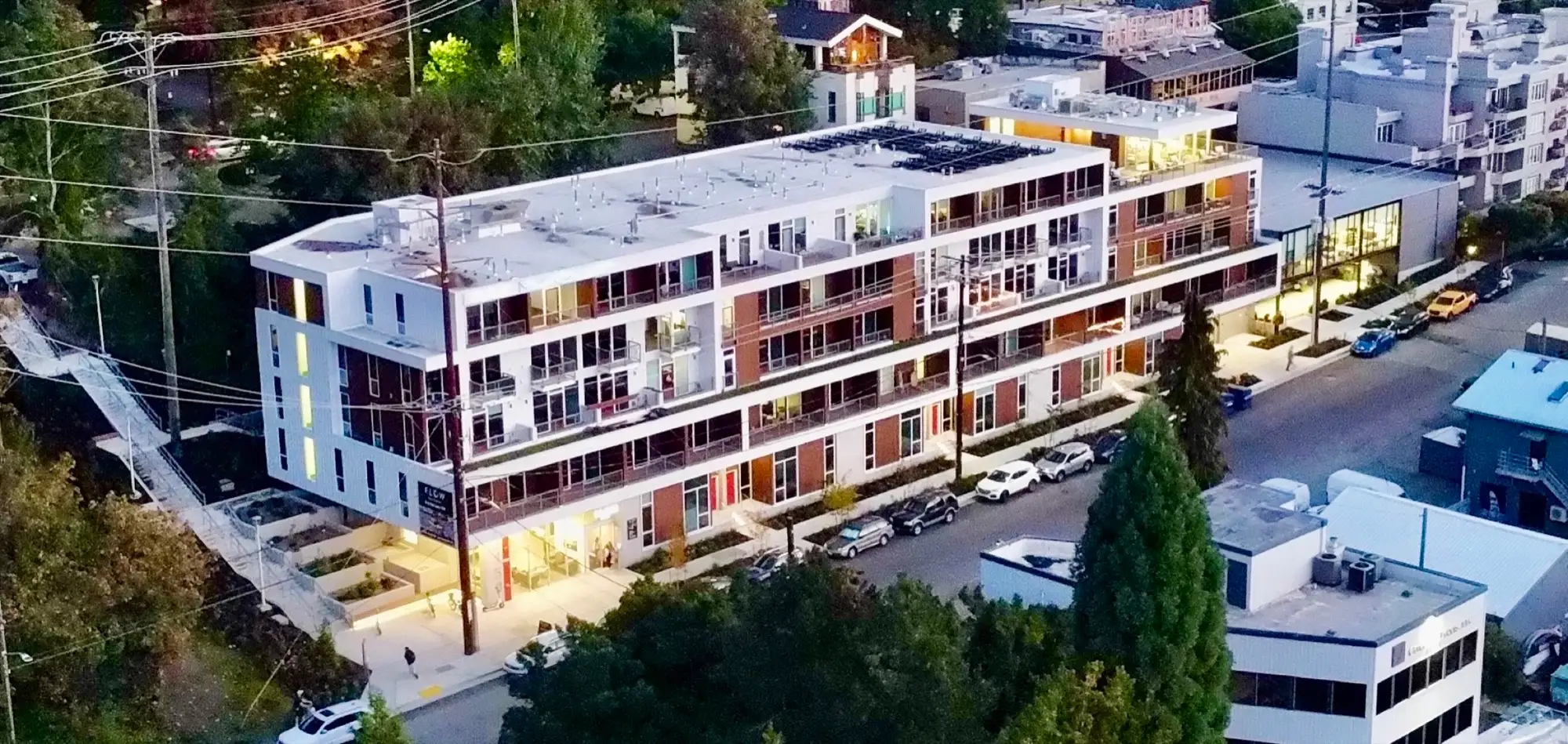
Flow Eastlake, our building at 3150 Fairview Ave E, is on the same street as Eastlake’s floating home docks and across the street from Lake Union. Residents get direct beach access, free kayak and paddleboard storage, and a rooftop lounge and terrace with a fire pit and grill. Homes range from studios to two bedrooms, including MFTE income-qualified homes. You can compare it with Lyla on our Eastlake apartments page, and our guide to living in Eastlake covers the rest of the neighborhood.
Quick answers
How many houseboats are in Seattle?
The Floating Homes Association counts 507 floating homes on 70 docks, and its history page adds roughly 250 other residential houseboats, almost all on Lake Union and Portage Bay. That is down from more than 2,000 in the late 1930s.
Where are the houseboats in Seattle?
Mostly on Lake Union and Portage Bay, in Eastlake, Westlake, Northlake, Portage Bay and the University District. In Eastlake, the docks run off Fairview Avenue East.
Can you rent a houseboat in Seattle?
Not for a short stay. The City prohibits using floating residences as rentals of fewer than 30 nights, and treats short-term rentals as a commercial use banned in all over-water locations.
Where can you see houseboats in Seattle?
From public street-end parks along Fairview Avenue East in Eastlake, such as Roanoke Street Mini Park and Lynn Street Mini Park, or from a kayak on the lake. The docks themselves are private.
Is there a Seattle houseboats tour?
Yes. The Floating Homes Association holds a self-guided Floating Homes Tour every other year, and the next one is planned for summer 2027.
Sources
All accessed 2026-11-09.
- Floating Homes Association, Maps: https://www.seattlefloatinghomes.org/floating-home-locations
- Floating Homes Association, The Beginnings: https://www.seattlefloatinghomes.org/history
- Floating Homes Association, Frequently Asked Questions: https://www.seattlefloatinghomes.org/intro-faqs
- Floating Homes Association, Floating Homes Tours: https://www.seattlefloatinghomes.org/tour
- Floating Homes Association, “Floating Home Museum Opens Dec. 18 and 19”: https://www.seattlefloatinghomes.org/post/planning-ahead-floating-home-museum-opens-dec-18-and-19
- HistoryLink, “Seattle Neighborhoods: Eastlake, Thumbnail History” (Essay 3255): https://www.historylink.org/File/3255
- HistoryLink, “Seattle’s Historic Houseboats” (Essay 9507): https://www.historylink.org/File/9507
- Seattle Department of Construction and Inspections, Floating Residences: https://www.seattle.gov/sdci/codes/common-code-questions/floating-residences
- Seattle Department of Construction and Inspections, Tip 229 (updated March 13, 2023): https://www.seattle.gov/DPD/Publications/CAM/cam229.pdf
- Seattle Municipal Code, Section 23.60A.202: https://library.municode.com/wa/seattle/codes/municipal_code?nodeId=TIT23LAUSCO_SUBTITLE_IIILAUSRE_CH23.60ASESHMAPRRE_PT5STAPSPUS_23.60A.202STFLHOFLHOMO
- King County, SciFYI, “Lake Union and the Ship Canal: A history of pollution and work toward a solution” (January 2017): https://your.kingcounty.gov/dnrp/library/water-and-land/science/newsletter/2017/january/lake-union-and-ship-canal-history-pollution.pdf
- Seattle Parks and Recreation, Terry Pettus Park: https://www.seattle.gov/parks/allparks/terry-pettus-park
- Seattle Parks and Recreation, Terry Pettus Park Renovation: https://www.seattle.gov/parks/about-us/projects/terry-pettus-park-renovation
- Seattle Parks and Recreation, Lynn Street Mini Park: https://www.seattle.gov/parks/parks/lynn-street-mini-park
- Seattle Parks and Recreation, Roanoke Street Mini Park: https://www.seattle.gov/parks/parks/roanoke-street-mini-park
- Eastlake Community Council, Eastlake Shoreline Walking Guide: https://www.eastlakeseattle.org/land/eastlake-shoreline-walking-guide